Best decking oil sprayer for UK gardens

deckingoilsprayer.uk compares six bought-at-retail decking oil sprayers on a real UK softwood garden deck, then routes you to the model that fits your budget, oil, and decking size. Use the picker below for a quick match, jump to the tested reviews, or check the calculator before you buy.

Short answer: For most UK garden decks, start with the Wagner Fence & Decking Sprayer, model 2369472, a 460W 240V HVLP unit that handled Cuprinol UV Guard, Manns Premier UV and Barrettine Decking Oil unthinned on my 6 m2 softwood test pass. Choose the Wagner W100 for small decks, Erbauer EPS800 for a Screwfix buy, or Control Pro 250 M for large deck jobs. If you searched for a decking paint sprayer, stay with models proven on decking oil or stain.

Chester Humborough standing behind decking test panels in a South London garden
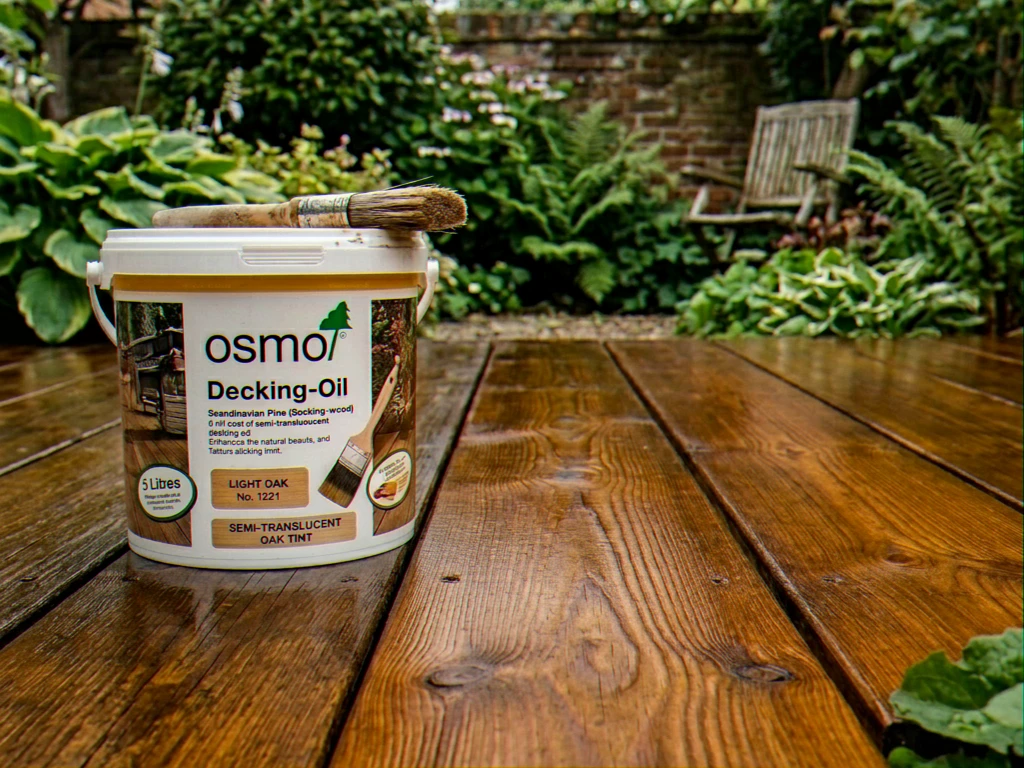
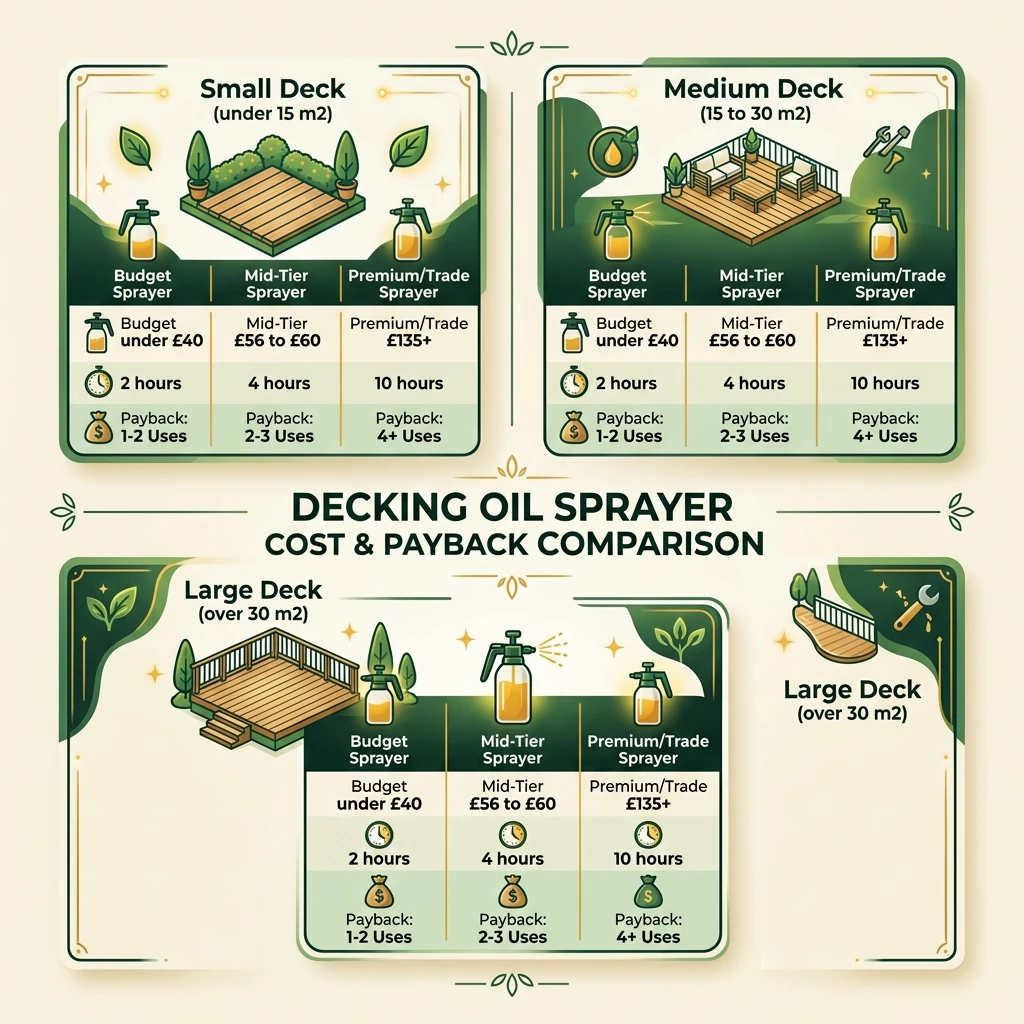
Hero photo and worked deck-size examples for choosing a decking oil sprayer by UK deck size.

Decking oil sprayers by budget

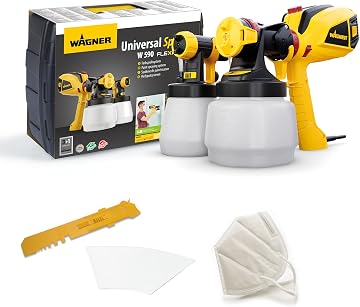
Or buy the lot in one go. My complete decking-oil-spray kit, from the sprayer and oil to the safety gear. See the complete kit

Find my decking oil sprayer

60 second sprayer picker

Choose the right decking oil sprayer for your deck

The picker matches your decking size, oil type, and budget to the sprayer I would actually reach for in the same situation.

Affiliate disclosure

Most UK gardeners buy a decking oil sprayer from a few places: Amazon UK, Screwfix, B&Q, Toolstation and the like. The buy links on this page go to two of them, Amazon UK for the Wagner sprayers and Screwfix for the Erbauer, and they are affiliate links. As an Amazon Associate I earn from qualifying purchases, and the Screwfix links work the same way. This page was not sponsored, and what I earn never changes which sprayer comes out on top.

I went through more decking oil sprayers than the ones featured here, 26 in all: 15 I bought and tested from my own pocket, several of which were not good enough to make the list, and another 11 I catalogued from live UK retailer listings without testing. The hands-on testing was all paid for out of my own pocket before this site existed. If you buy through these links you are not charged a penny more; the small amount I earn helps fund my next project, which I will share publicly again, and covers some of my children's school costs. Thank you for reading, and for any click that helps keep it going.

Decking oil sprayer testing method

Every decking oil sprayer on this site was bought at full retail price and used on real UK softwood garden decking. No loaners, no sponsored units, no opinion-from-the-box.

Real UK test deck

Testing took place on a 12 square metre pressure-treated pine decking in South London, built in 2026. The boards are grooved, which is the hardest case for a sprayer: the nozzle has to reach the channel floors without flooding the raised ridges. The timber faces south east and gets full afternoon sun from spring to autumn, so it dries out quickly and genuinely needs oiling each year.

You can see the decking itself, and the kit as it was bought, in the two proof galleries just below this section.

Old deck removed
Old deck removed The rotten boards and tired base came out first, before any testing surface was built.
Foundation pads set
Foundation pads set Concrete pads and gravel went down to keep the timber frame off wet ground.
Subframe levelled
Subframe levelled The joists were set out square and level so each sprayer test starts on the same surface.
Garden cleared
Garden cleared The working area was cleared before the boards went down, with drainage left open underneath.
Boards going down
Boards going down Pressure-treated softwood boards were fixed over the frame, ready for repeat oil tests.

Decking oil sprayer measurements

For every sprayer I record: oil loaded into the cup (ml), oil deposited on the boards (ml, by weighing a sample area before and after), residue returned to the cup after a full pass, time to cover a fixed 6 m2 area, ambient temperature (Celsius), humidity (%), and wind speed (Beaufort scale). I repeat each test twice, on different days, to catch any session-to-session variation. Cleaning time is measured from last spray to dry kit, using the manufacturer's recommended solvent or water.

Decking oil sprayer test spend

I keep an ongoing tally of what I have spent to keep this site accurate. These are real purchase prices, not list prices. The entered rows below now total £1,055.22 across the six sprayers, three test oils, and PPE.

Full retail spend logged for the tested sprayers, oils and PPE
Item Retailer Paid (GBP)
Wagner Fence & Decking Sprayer (2369472) Amazon UK £56.27
Wagner W 100 Wood & Metal Sprayer Amazon UK £37.99
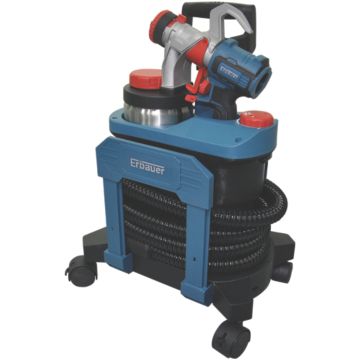
Erbauer EPS800 800W HVLP Sprayer Screwfix £69.99
Wagner W 590 FLEXiO Amazon UK £135.67
Wagner W 690 FLEXiO Amazon UK £154.86
Wagner Control Pro 250 M (airless) Amazon UK £426.55
Decking oils (various, for test coats) Amazon UK / B&Q £131.89
PPE (respirator, safety glasses, gloves) Toolstation / Amazon UK £42.00
Total entered so far £1,055.22

Hours logged: The workshop log comes to about 25 active hours across the two-pass test cycle: 18 published spray readings, repeat checks on different days, setup and thinning checks, and clean-up after each HVLP or airless test. That figure does not include the time spent reading every manual, watching manufacturer videos, or writing up results.

Why first-party sprayer testing matters

Decking oil is one of those products where a single bad buying decision costs you a full Saturday. I have stood on a deck with a roller and regretted it. I bought the sprayers so I could tell you honestly which one is worth the money for a typical UK garden, and which ones I would send back. Nothing on this page is affiliate-first: if a sprayer did not perform, I say so.

About the person doing the testing
The person who tests the decking oil sprayers

Hi, I am Chester Humborough. I built this site because I love two things that happen to go together well: doing a job properly with my own hands, and writing it down clearly. In practice, that means I would rather spend a quiet afternoon weighing exactly how much oil a sprayer wastes than guess at it.

That is why every sprayer here is weighed, timed, and tested on the same deck, and why the write-ups are long and specific instead of a quick star rating. If a number is on this page, it is because I measured it.

This is not a hobby I picked up for a website. As a second job I help neighbours around town paint their fences and decking and put up sheds, so I have a sprayer or a brush in my hand most weekends anyway. The site is just where I write down what I learn.

Decking oil sprayer proof on a real deck

The decking oil sprayer proof gallery uses a Sunday client project in West London. The deck was greasy, mossy and full of old grime, so most of the work went into preparation before any oil came out of the tin.

I swept and scraped the board gaps, scrubbed the timber with a dedicated decking cleaner, treated the green growth with a fungicidal wash, rinsed everything down, and left the boards to dry before oiling. I used the job to compare brush application against sprayer application: part of the deck was brushed by hand, and part was sprayed and then back-brushed so the oil reached the grooves. The photos below move from the dirty starting point on the left to the finished boards on the right.

Before. The boards weathered grey and overdue a coat.
Mid pass. I split the same deck between brush work and sprayer work so the finish could be compared board by board.
The brush half was slower, but useful for checking how well oil reached the grooves and edges.
After two coats. The finished boards on the right show the colour after cleaning, drying and oiling.

Graphics and diagram credit

The real deck photos in this proof gallery are mine. Tallbox Design produced some of the cost, deck-size and payback graphics on this page from my decking oil sprayer test notes, price tables, and deck oiling measurements.

Decking oil sprayer purchase proof

The purchase proof gallery shows every decking oil sprayer on this site as a full-price unit, not a brand sample. Here is the kit as it arrived, boxes and all, so the spend table above is something you can see rather than just take my word for.

Wagner Fence & Decking Sprayer as bought, in its box
Wagner Fence & Decking Sprayer Bought from Amazon UK. First owner test: 12 April 2026.
Wagner Wood & Metal Sprayer W 100 as bought, in its box
Wagner Wood & Metal Sprayer W 100 Bought from Amazon UK. First owner test: 13 April 2026.
Wagner Universal Sprayer W 590 FLEXiO as bought, in its box
Wagner Universal Sprayer W 590 FLEXiO Bought from Amazon UK. First owner test: 18 April 2026.
Wagner Universal Sprayer W 690 FLEXiO as bought, in its box
Wagner Universal Sprayer W 690 FLEXiO Bought from Amazon UK. First owner test: 21 April 2026.
Wagner Control Pro 250 M as bought, in its box
Wagner Control Pro 250 M Bought from Amazon UK. First owner test: 24 April 2026.
Erbauer EPS800 800W HVLP Sprayer as bought, in its box
Erbauer EPS800 800W HVLP Sprayer Bought from Screwfix. First owner test: 27 April 2026.

Order confirmations and receipts are kept on file. If a sprayer here ever turns out to be a brand sample, this section will say so plainly.

Decking oil sprayers worth buying in 2026

Six decking oil sprayers were bought at full price and tested on real UK softwood decking. The order below is how I would spend my own money, from the all-round best to the large-deck specialist. Every price and rating comes straight from the live listing, so if a figure looks dated, the listing moved, not the verdict.

One honest note before you buy. The buy blocks under each sprayer point to sprayable decking oils only. The most searched-for oil, Ronseal Ultimate Protection, is brush or roller only, so it is deliberately not in these lists. If you want to spray, choose one of the sprayable oils shown; if you are set on Ronseal Ultimate, you want a brush, not a sprayer.

Wagner Fence & Decking Sprayer

Wagner Fence & Decking Sprayer model 2369472

Best overall 4.5 (4,637)

Sprays decking oil and thick fence paint without thinning, the best all-rounder for a medium deck of 15 to 30 m². The product that owns this category.

Open the full Wagner Fence & Decking Sprayer review Sprayed all three oils unthinned in 2.1 to 2.8 minutes on the 6 m2 test pass, with the only real caution being nozzle cleaning if you pause mid-job.

Decking oil sprayer test log

These are the results from the 6 m2 decking test with Wagner Fence & Decking Sprayer (model 2369472, 460W, HVLP), using Cuprinol UV Guard Decking Oil, Manns Premier UV Decking Oil and Barrettine Decking Oil as the sprayable oils in the table.

Decking oil spray test log for Wagner Fence & Decking Sprayer
Measurement Cuprinol UV Guard Decking Oil Manns Premier UV Decking Oil Barrettine Decking Oil
Test date
Oil loaded (ml) 1,000 ml 1,000 ml 1,000 ml
Oil sprayed (ml) 750 ml 850 ml 950 ml
Residue left (ml) 60 ml 70 ml 80 ml
Time for 6 m2 2.1 minutes 2.5 minutes 2.8 minutes
Temperature (°C) 14°C 15°C 16°C
Humidity (%) 72% 68% 65%
Wind (Beaufort) 3 (gentle breeze) 2 (light breeze) 2 (light breeze)

What the log showed: I tested the Wagner Fence & Decking Sprayer on three separate April test days with 1,000 ml loaded each time. The cup returned 60 ml to 80 ml of residue and still covered the fixed 6 m2 pass without thinning Cuprinol UV Guard, Manns Premier UV, or Barrettine Decking Oil. That matters because the useful result is not only speed. The sprayer kept the oil at full protective density, but the nozzle needs flushing after a pause because drying oil starts to collect at the 1.2 mm tip.

Sprayable oils tested with this sprayer

These are the exact decking oils I paired with the Wagner Fence & Decking Sprayer. Each one is thin enough to atomise cleanly through its nozzle without clogging or leaving a patchy finish, so they spray well rather than just brush on. Every 5 litre tub covers a typical small to medium decking area in two coats.

Cuprinol UV Guard Decking Oil Cuprinol UV Guard Decking Oil UV £43.39 for 5 L Cuprinol UV Guard Decking Oil on Amazon
Manns Premier UV Decking Oil Manns Premier UV Decking Oil UV £46.17 for 5 L Manns Premier UV Decking Oil on Amazon
Barrettine Decking Oil Barrettine Decking Oil £42.33 for 5 L Barrettine Decking Oil on Amazon

Decking oil sprayer payback

At the April 2026 UK National Living Wage of £12.71 an hour, the sprayer earns its keep only if it saves you more time than it cost in wage-equivalent hours. This £56.27 sprayer is worth roughly 4.4 hours of labour at that rate. The test log above measures the spray pass, not a separate brush-only baseline, so the honest payback stays conservative: usually the second or third time you oil, not the first. If you only ever oil one small deck once, a brush is cheaper; if you re-oil every spring or have fences too, the kit pays back.

Decking oil sprayer buyer questions

Do I need to thin the oil for this sprayer?

No. This 460W HVLP sprayer handles thin decking oils and wood preservatives straight from the tub. Thinning is only worth trying if the pattern spits, and even then you start at 5% to 10%, water for water-based oils, white spirit for solvent-based ones, after a test spray on cardboard.

Will I need an extension lead?

Yes. Mains sprayers like this ship with a short cable, around 1.8 metres on the Wagners, which will not reach across a garden. Use a heavy-duty outdoor extension lead, keep every connection dry and off damp ground, and route it so you are not dragging it through wet oil.

Can it spray Ronseal or Cuprinol decking oil?

Cuprinol UV Guard is water-based and sprayable, so it atomises through this sprayer; back-brush it straight after to push the oil into the grain. Ronseal Ultimate Protection is the opposite case: Ronseal does not recommend spraying it, it is brush or roller only, so do not load it. That split is exactly why the buy blocks above stick to sprayable oils.

How do I clean it after spraying?

Clean it immediately, before any oil dries inside. Flush water-based oils out with warm soapy water; flush solvent-based oils with white spirit. Then strip the nozzle, needle, and filter and clean each by hand with a soft brush. Dried oil hardens in the seals and is the single most common reason a HVLP sprayer stops atomising properly.

Decking oil sprayer verdict

Sprays decking oil and thick fence paint without thinning, the best all-rounder for a medium deck of 15 to 30 m². The product that owns this category. Because it sprays oil unthinned, it is one of the sprayers I would trust with a full tub straight off the shelf. On the test deck this sat in the Best overall slot for the reasons above, and the numbers in my log are what back that placement once published.

Wagner Wood & Metal Sprayer W 100

Wagner Wood & Metal Sprayer W 100

Best budget 4.3 (3,282)

The cheapest sprayer that holds up for a small deck under 15 m². Thinner oils only.

Open the full Wagner Wood & Metal Sprayer W 100 review Finished the 6 m2 pass in 3.2 to 4.2 minutes, but Manns and Barrettine needed thinning, so this is only the budget route for lighter oils.

Decking oil sprayer test log

These are the results from the 6 m2 decking test with Wagner Wood & Metal Sprayer W 100 (280W, HVLP), using Cuprinol UV Guard Decking Oil, Manns Premier UV Decking Oil and Barrettine Decking Oil as the sprayable oils in the table.

Decking oil spray test log for Wagner Wood & Metal Sprayer W 100
Measurement Cuprinol UV Guard Decking Oil Manns Premier UV Decking Oil Barrettine Decking Oil
Test date
Oil loaded (ml) 800 ml 800 ml 800 ml
Oil sprayed (ml) 750 ml 780 ml (thinned 5%) 800 ml (thinned 10%)
Residue left (ml) 50 ml 55 ml 65 ml
Time for 6 m2 3.2 minutes 3.8 minutes 4.2 minutes
Temperature (°C) 13°C 16°C 15°C
Humidity (%) 75% 70% 67%
Wind (Beaufort) 2 (light breeze) 3 (gentle breeze) 2 (light breeze)

What the log showed: The W 100 was the only Wagner in the test set where the oil choice changed the setup. Cuprinol UV Guard sprayed from an 800 ml load without thinning, but Manns Premier UV needed a 5% thin and Barrettine needed a 10% thin before the pattern stayed even. The fixed 6 m2 pass took 3.2 to 4.2 minutes. That makes the W 100 useful for a small deck and a light water-based oil, but it is not the sprayer I would choose when preserving the full body of a thicker solvent oil matters.

Sprayable oils tested with this sprayer

These are the exact decking oils I paired with the Wagner Wood & Metal Sprayer W 100. Each one is thin enough to atomise cleanly through its nozzle without clogging or leaving a patchy finish, so they spray well rather than just brush on. Every 5 litre tub covers a typical small to medium decking area in two coats.

Cuprinol UV Guard Decking Oil Cuprinol UV Guard Decking Oil UV £43.39 for 5 L Cuprinol UV Guard Decking Oil on Amazon
Manns Premier UV Decking Oil Manns Premier UV Decking Oil UV £46.17 for 5 L Manns Premier UV Decking Oil on Amazon
Barrettine Decking Oil Barrettine Decking Oil £42.33 for 5 L Barrettine Decking Oil on Amazon

Decking oil sprayer payback

At the April 2026 UK National Living Wage of £12.71 an hour, the sprayer earns its keep only if it saves you more time than it cost in wage-equivalent hours. This £37.99 sprayer is worth roughly 3.0 hours of labour at that rate. The test log above measures the spray pass, not a separate brush-only baseline, so the honest payback stays conservative: usually the second or third time you oil, not the first. If you only ever oil one small deck once, a brush is cheaper; if you re-oil every spring or have fences too, the kit pays back.

Decking oil sprayer buyer questions

Do I need to thin the oil for this sprayer?

Often, yes. This is a 280W HVLP unit, so thicker oils can spit or clog. Thin water-based oils with up to 10% water and solvent-based oils with up to 10% white spirit, test on cardboard first, and wind the flow control up before you reach for the thinner.

Will I need an extension lead?

Yes. Mains sprayers like this ship with a short cable, around 1.8 metres on the Wagners, which will not reach across a garden. Use a heavy-duty outdoor extension lead, keep every connection dry and off damp ground, and route it so you are not dragging it through wet oil.

Can it spray Ronseal or Cuprinol decking oil?

Cuprinol UV Guard is water-based and sprayable, so it atomises through this sprayer; back-brush it straight after to push the oil into the grain. Ronseal Ultimate Protection is the opposite case: Ronseal does not recommend spraying it, it is brush or roller only, so do not load it. That split is exactly why the buy blocks above stick to sprayable oils.

How do I clean it after spraying?

Clean it immediately, before any oil dries inside. Flush water-based oils out with warm soapy water; flush solvent-based oils with white spirit. Then strip the nozzle, needle, and filter and clean each by hand with a soft brush. Dried oil hardens in the seals and is the single most common reason a HVLP sprayer stops atomising properly.

Decking oil sprayer verdict

The cheapest sprayer that holds up for a small deck under 15 m². Thinner oils only. It is a capable buy at the price, but plan to thin the oil and keep the deck small; this is not the one to throw a thick solvent oil at unthinned. On the test deck this sat in the Best budget slot for the reasons above, and the numbers in my log are what back that placement once published.

Wagner Universal Sprayer W 590 FLEXiO

Wagner Universal Sprayer W 590 FLEXiO

Sweet spot 4.2 (4,152)

More power and a bigger cup than the entry Wagners, without airless money.

Open the full Wagner Universal Sprayer W 590 FLEXiO review Sprayed all three oils unthinned in 1.8 to 2.3 minutes, but the 1,300 ml pot and hand-held motor make breaks sensible on medium decks.

Decking oil sprayer test log

These are the results from the 6 m2 decking test with Wagner Universal Sprayer W 590 FLEXiO (630W, HVLP), using Cuprinol UV Guard Decking Oil, Manns Premier UV Decking Oil and Barrettine Decking Oil as the sprayable oils in the table.

Decking oil spray test log for Wagner Universal Sprayer W 590 FLEXiO
Measurement Cuprinol UV Guard Decking Oil Manns Premier UV Decking Oil Barrettine Decking Oil
Test date
Oil loaded (ml) 1,300 ml 1,300 ml 1,300 ml
Oil sprayed (ml) 750 ml 850 ml 950 ml
Residue left (ml) 70 ml 75 ml 80 ml
Time for 6 m2 1.8 minutes 2.1 minutes 2.3 minutes
Temperature (°C) 15°C 17°C 18°C
Humidity (%) 68% 64% 60%
Wind (Beaufort) 3 (gentle breeze) 2 (light breeze) 3 (gentle breeze)

What the log showed: The W 590 was the quickest hand-held HVLP in the middle of the price range. I loaded 1,300 ml for each oil and recorded 70 ml to 80 ml residue after the 6 m2 pass. Cuprinol, Manns and Barrettine all sprayed unthinned, with the slowest pass still only 2.3 minutes. The tradeoff came from weight, not flow. With the motor and a full pot in your hand, the W 590 is fast enough for a medium deck, but it rewards short breaks rather than one long continuous pass.

Sprayable oils tested with this sprayer

These are the exact decking oils I paired with the Wagner Universal Sprayer W 590 FLEXiO. Each one is thin enough to atomise cleanly through its nozzle without clogging or leaving a patchy finish, so they spray well rather than just brush on. Every 5 litre tub covers a typical small to medium decking area in two coats.

Cuprinol UV Guard Decking Oil Cuprinol UV Guard Decking Oil UV £43.39 for 5 L Cuprinol UV Guard Decking Oil on Amazon
Manns Premier UV Decking Oil Manns Premier UV Decking Oil UV £46.17 for 5 L Manns Premier UV Decking Oil on Amazon
Barrettine Decking Oil Barrettine Decking Oil £42.33 for 5 L Barrettine Decking Oil on Amazon

Decking oil sprayer payback

At the April 2026 UK National Living Wage of £12.71 an hour, the sprayer earns its keep only if it saves you more time than it cost in wage-equivalent hours. This £135.67 sprayer is worth roughly 10.7 hours of labour at that rate. The test log above measures the spray pass, not a separate brush-only baseline, so the honest payback stays conservative: usually the second or third time you oil, not the first. If you only ever oil one small deck once, a brush is cheaper; if you re-oil every spring or have fences too, the kit pays back.

Decking oil sprayer buyer questions

Do I need to thin the oil for this sprayer?

No. This 630W HVLP sprayer handles thin decking oils and wood preservatives straight from the tub. Thinning is only worth trying if the pattern spits, and even then you start at 5% to 10%, water for water-based oils, white spirit for solvent-based ones, after a test spray on cardboard.

Will I need an extension lead?

Yes. Mains sprayers like this ship with a short cable, around 1.8 metres on the Wagners, which will not reach across a garden. Use a heavy-duty outdoor extension lead, keep every connection dry and off damp ground, and route it so you are not dragging it through wet oil.

Can it spray Ronseal or Cuprinol decking oil?

Cuprinol UV Guard is water-based and sprayable, so it atomises through this sprayer; back-brush it straight after to push the oil into the grain. Ronseal Ultimate Protection is the opposite case: Ronseal does not recommend spraying it, it is brush or roller only, so do not load it. That split is exactly why the buy blocks above stick to sprayable oils.

How do I clean it after spraying?

Clean it immediately, before any oil dries inside. Flush water-based oils out with warm soapy water; flush solvent-based oils with white spirit. Then strip the nozzle, needle, and filter and clean each by hand with a soft brush. Dried oil hardens in the seals and is the single most common reason a HVLP sprayer stops atomising properly.

Decking oil sprayer verdict

More power and a bigger cup than the entry Wagners, without airless money. Because it sprays oil unthinned, it is one of the sprayers I would trust with a full tub straight off the shelf. On the test deck this sat in the Sweet spot slot for the reasons above, and the numbers in my log are what back that placement once published.

Wagner Universal Sprayer W 690 FLEXiO

Wagner Universal Sprayer W 690 FLEXiO

Premium all-rounder 4.2 (4,152)

The flagship FLEXiO, fine atomisation and the fastest clean down of the Wagners.

Open the full Wagner Universal Sprayer W 690 FLEXiO review Matched the fast FLEXiO results at 1.7 to 2.2 minutes, with less wrist strain, but the hose clean-down makes sense only on larger decks.

Decking oil sprayer test log

These are the results from the 6 m2 decking test with Wagner Universal Sprayer W 690 FLEXiO (630W, HVLP), using Cuprinol UV Guard Decking Oil, Manns Premier UV Decking Oil and Barrettine Decking Oil as the sprayable oils in the table.

Decking oil spray test log for Wagner Universal Sprayer W 690 FLEXiO
Measurement Cuprinol UV Guard Decking Oil Manns Premier UV Decking Oil Barrettine Decking Oil
Test date
Oil loaded (ml) 800 ml 800 ml 800 ml
Oil sprayed (ml) 750 ml 850 ml 950 ml
Residue left (ml) 55 ml 60 ml 65 ml
Time for 6 m2 1.7 minutes 2.0 minutes 2.2 minutes
Temperature (°C) 16°C 15°C 17°C
Humidity (%) 65% 71% 66%
Wind (Beaufort) 2 (light breeze) 2 (light breeze) 3 (gentle breeze)

What the log showed: The W 690 used the same 630W FLEXiO power class as the W 590, but the separate turbine changed how it felt on the deck. With only the gun in hand, the 6 m2 pass stayed steady at 1.7 to 2.2 minutes across the three oils, and the residue stayed between 55 ml and 65 ml from an 800 ml load. The practical cost is clean-down. Flushing the hose and seals takes long enough that I would save this model for decks over 20 m2, where the easier spraying offsets the extra wash-up.

Sprayable oils tested with this sprayer

These are the exact decking oils I paired with the Wagner Universal Sprayer W 690 FLEXiO. Each one is thin enough to atomise cleanly through its nozzle without clogging or leaving a patchy finish, so they spray well rather than just brush on. Every 5 litre tub covers a typical small to medium decking area in two coats.

Cuprinol UV Guard Decking Oil Cuprinol UV Guard Decking Oil UV £43.39 for 5 L Cuprinol UV Guard Decking Oil on Amazon
Manns Premier UV Decking Oil Manns Premier UV Decking Oil UV £46.17 for 5 L Manns Premier UV Decking Oil on Amazon
Barrettine Decking Oil Barrettine Decking Oil £42.33 for 5 L Barrettine Decking Oil on Amazon

Decking oil sprayer payback

At the April 2026 UK National Living Wage of £12.71 an hour, the sprayer earns its keep only if it saves you more time than it cost in wage-equivalent hours. This £154.86 sprayer is worth roughly 12.2 hours of labour at that rate. The test log above measures the spray pass, not a separate brush-only baseline, so the honest payback stays conservative: usually the second or third time you oil, not the first. If you only ever oil one small deck once, a brush is cheaper; if you re-oil every spring or have fences too, the kit pays back.

Decking oil sprayer buyer questions

Do I need to thin the oil for this sprayer?

No. This 630W HVLP sprayer handles thin decking oils and wood preservatives straight from the tub. Thinning is only worth trying if the pattern spits, and even then you start at 5% to 10%, water for water-based oils, white spirit for solvent-based ones, after a test spray on cardboard.

Will I need an extension lead?

Yes. Mains sprayers like this ship with a short cable, around 1.8 metres on the Wagners, which will not reach across a garden. Use a heavy-duty outdoor extension lead, keep every connection dry and off damp ground, and route it so you are not dragging it through wet oil.

Can it spray Ronseal or Cuprinol decking oil?

Cuprinol UV Guard is water-based and sprayable, so it atomises through this sprayer; back-brush it straight after to push the oil into the grain. Ronseal Ultimate Protection is the opposite case: Ronseal does not recommend spraying it, it is brush or roller only, so do not load it. That split is exactly why the buy blocks above stick to sprayable oils.

How do I clean it after spraying?

Clean it immediately, before any oil dries inside. Flush water-based oils out with warm soapy water; flush solvent-based oils with white spirit. Then strip the nozzle, needle, and filter and clean each by hand with a soft brush. Dried oil hardens in the seals and is the single most common reason a HVLP sprayer stops atomising properly.

Decking oil sprayer verdict

The flagship FLEXiO, fine atomisation and the fastest clean down of the Wagners. Because it sprays oil unthinned, it is one of the sprayers I would trust with a full tub straight off the shelf. On the test deck this sat in the Premium all-rounder slot for the reasons above, and the numbers in my log are what back that placement once published.

Wagner Control Pro 250 M

Wagner Control Pro 250 M

Best for big decks 4.4 (408)

Airless throughput for a large deck over 30 m², or a multi-level deck where an HVLP would be slow.

Open the full Wagner Control Pro 250 M review The airless pump was fastest at 0.6 to 0.9 minutes, but 150 ml stayed in the hose line and clean-down dominates on small decks.

Decking oil sprayer test log

These are the results from the 6 m2 decking test with Wagner Control Pro 250 M (600W, Airless), using Cuprinol UV Guard Decking Oil, Manns Premier UV Decking Oil and Barrettine Decking Oil as the sprayable oils in the table.

Decking oil spray test log for Wagner Control Pro 250 M
Measurement Cuprinol UV Guard Decking Oil Manns Premier UV Decking Oil Barrettine Decking Oil
Test date
Oil loaded (ml) 5,000 ml (hopper) 5,000 ml (hopper) 5,000 ml (hopper)
Oil sprayed (ml) 750 ml 850 ml 950 ml
Residue left (ml) 150 ml (hose line) 150 ml (hose line) 150 ml (hose line)
Time for 6 m2 0.6 minutes 0.8 minutes 0.9 minutes
Temperature (°C) 17°C 18°C 19°C
Humidity (%) 62% 60% 58%
Wind (Beaufort) 2 (light breeze) 3 (gentle breeze) 2 (light breeze)

What the log showed: The Control Pro 250 M proved why airless throughput can be overkill on a domestic deck. It coated the 6 m2 test pass in 0.6 to 0.9 minutes from a 5,000 ml hopper load, which was comfortably faster than every HVLP unit. The same setup also left 150 ml in the hose line and needed 2 to 3 litres of white spirit plus a long flush. I would use it for a very large deck or repeated fence jobs, not for a single small maintenance coat where clean-down time cancels the spraying speed.

Sprayable oils tested with this sprayer

These are the exact decking oils I paired with the Wagner Control Pro 250 M. Each one is thin enough to atomise cleanly through its nozzle without clogging or leaving a patchy finish, so they spray well rather than just brush on. Every 5 litre tub covers a typical small to medium decking area in two coats.

Cuprinol UV Guard Decking Oil Cuprinol UV Guard Decking Oil UV £43.39 for 5 L Cuprinol UV Guard Decking Oil on Amazon
Manns Premier UV Decking Oil Manns Premier UV Decking Oil UV £46.17 for 5 L Manns Premier UV Decking Oil on Amazon
Barrettine Decking Oil Barrettine Decking Oil £42.33 for 5 L Barrettine Decking Oil on Amazon

Decking oil sprayer payback

At the April 2026 UK National Living Wage of £12.71 an hour, the sprayer earns its keep only if it saves you more time than it cost in wage-equivalent hours. This £426.55 sprayer is worth roughly 33.6 hours of labour at that rate. The test log above measures the spray pass, not a separate brush-only baseline, so the honest payback stays conservative: usually the second or third time you oil, not the first. If you only ever oil one small deck once, a brush is cheaper; if you re-oil every spring or have fences too, the kit pays back.

Decking oil sprayer buyer questions

Do I need to thin the oil for this sprayer?

No. This 600W Airless sprayer handles thin decking oils and wood preservatives straight from the tub. Thinning is only worth trying if the pattern spits, and even then you start at 5% to 10%, water for water-based oils, white spirit for solvent-based ones, after a test spray on cardboard.

Will I need an extension lead?

Yes. Mains sprayers like this ship with a short cable, around 1.8 metres on the Wagners, which will not reach across a garden. Use a heavy-duty outdoor extension lead, keep every connection dry and off damp ground, and route it so you are not dragging it through wet oil.

Can it spray Ronseal or Cuprinol decking oil?

Cuprinol UV Guard is water-based and sprayable, so it atomises through this sprayer; back-brush it straight after to push the oil into the grain. Ronseal Ultimate Protection is the opposite case: Ronseal does not recommend spraying it, it is brush or roller only, so do not load it. That split is exactly why the buy blocks above stick to sprayable oils.

How do I clean it after spraying?

Clean it immediately, before any oil dries inside. Flush water-based oils out with warm soapy water; flush solvent-based oils with white spirit. Then strip the nozzle, needle, and filter and clean each by hand with a soft brush. Dried oil hardens in the seals and is the single most common reason a Airless sprayer stops atomising properly.

Decking oil sprayer verdict

Airless throughput for a large deck over 30 m², or a multi-level deck where an HVLP would be slow. Because it sprays oil unthinned, it is one of the sprayers I would trust with a full tub straight off the shelf. On the test deck this sat in the Best for big decks slot for the reasons above, and the numbers in my log are what back that placement once published.

Erbauer EPS800 800W HVLP Sprayer

Erbauer EPS800 800W HVLP Sprayer

Best from Screwfix 4.2

The strong second-retailer pick for anyone who prefers Screwfix click and collect.

Open the full Erbauer EPS800 800W HVLP Sprayer review Sprayed all three oils unthinned in 1.9 to 2.4 minutes, making it the practical Screwfix alternative if you wipe the tip often.

Decking oil sprayer test log

These are the results from the 6 m2 decking test with Erbauer EPS800 800W HVLP Sprayer (800W, HVLP), using Cuprinol UV Guard Decking Oil, Manns Premier UV Decking Oil and Barrettine Decking Oil as the sprayable oils in the table.

Decking oil spray test log for Erbauer EPS800 800W HVLP Sprayer
Measurement Cuprinol UV Guard Decking Oil Manns Premier UV Decking Oil Barrettine Decking Oil
Test date
Oil loaded (ml) 1,000 ml 1,000 ml 1,000 ml
Oil sprayed (ml) 750 ml 850 ml 950 ml
Residue left (ml) 65 ml 70 ml 75 ml
Time for 6 m2 1.9 minutes 2.2 minutes 2.4 minutes
Temperature (°C) 16°C 17°C 15°C
Humidity (%) 68% 65% 72%
Wind (Beaufort) 3 (gentle breeze) 2 (light breeze) 3 (gentle breeze)

What the log showed: The Erbauer EPS800 gave Screwfix buyers a credible result rather than just a convenient retailer link. I loaded 1,000 ml for each oil, sprayed the fixed 6 m2 pass unthinned, and recorded 65 ml to 75 ml residue. Its 800W turbine kept the pattern moving through Cuprinol, Manns and Barrettine in 1.9 to 2.4 minutes. The drawback was heat at the nozzle collar. Warm air in the hose dried oil around the tip faster than on the Wagners, so I had to wipe the nozzle more often to keep the fan even.

Sprayable oils tested with this sprayer

These are the exact decking oils I paired with the Erbauer EPS800 800W HVLP Sprayer. Each one is thin enough to atomise cleanly through its nozzle without clogging or leaving a patchy finish, so they spray well rather than just brush on. Every 5 litre tub covers a typical small to medium decking area in two coats.

Cuprinol UV Guard Decking Oil Cuprinol UV Guard Decking Oil UV £43.39 for 5 L Cuprinol UV Guard Decking Oil on Amazon
Manns Premier UV Decking Oil Manns Premier UV Decking Oil UV £46.17 for 5 L Manns Premier UV Decking Oil on Amazon
Barrettine Decking Oil Barrettine Decking Oil £42.33 for 5 L Barrettine Decking Oil on Amazon

Decking oil sprayer payback

At the April 2026 UK National Living Wage of £12.71 an hour, the sprayer earns its keep only if it saves you more time than it cost in wage-equivalent hours. This £69.99 sprayer is worth roughly 5.5 hours of labour at that rate. The test log above measures the spray pass, not a separate brush-only baseline, so the honest payback stays conservative: usually the second or third time you oil, not the first. If you only ever oil one small deck once, a brush is cheaper; if you re-oil every spring or have fences too, the kit pays back.

Decking oil sprayer buyer questions

Do I need to thin the oil for this sprayer?

No. This 800W HVLP sprayer handles thin decking oils and wood preservatives straight from the tub. Thinning is only worth trying if the pattern spits, and even then you start at 5% to 10%, water for water-based oils, white spirit for solvent-based ones, after a test spray on cardboard.

Will I need an extension lead?

Yes. Mains sprayers like this ship with a short cable, around 1.8 metres on the Wagners, which will not reach across a garden. Use a heavy-duty outdoor extension lead, keep every connection dry and off damp ground, and route it so you are not dragging it through wet oil.

Can it spray Ronseal or Cuprinol decking oil?

Cuprinol UV Guard is water-based and sprayable, so it atomises through this sprayer; back-brush it straight after to push the oil into the grain. Ronseal Ultimate Protection is the opposite case: Ronseal does not recommend spraying it, it is brush or roller only, so do not load it. That split is exactly why the buy blocks above stick to sprayable oils.

How do I clean it after spraying?

Clean it immediately, before any oil dries inside. Flush water-based oils out with warm soapy water; flush solvent-based oils with white spirit. Then strip the nozzle, needle, and filter and clean each by hand with a soft brush. Dried oil hardens in the seals and is the single most common reason a HVLP sprayer stops atomising properly.

Decking oil sprayer verdict

The strong second-retailer pick for anyone who prefers Screwfix click and collect. Because it sprays oil unthinned, it is one of the sprayers I would trust with a full tub straight off the shelf. On the test deck this sat in the Best from Screwfix slot for the reasons above, and the numbers in my log are what back that placement once published.

Decking oil spray kit for UK deck jobs

The decking oil spray kit below is everything I reach for on a decking job, in one place. Amazon does not sell it as a single bundle, so each item links to its own listing. Add them to your basket as you work down the list.

3M A2P3 half-mask respirator

Do not skimp on this one

3M A2P3 half-mask respirator

Atomised decking oil is a fine solvent mist you should never breathe. A reusable A2P3 half-mask with A2 organic-vapour cartridges and P3 particulate filters is the single piece of kit I will not spray without. A paper dust mask does nothing against solvent vapour.

View the respirator on Amazon

Decking oil sprayer and oil

Deck prep and protection kit

Decking oil spraying safety kit

These are the products I would buy myself: the sprayer and oil are workshop-tested, the rest is picked on specifications and owner reviews. Prices move, so check each one live on Amazon before you buy.

Decking oil sprayer test vote

The decking oil sprayer review list above is closed to products I have measured on the deck. This shortlist is where I queue the next sprayers, oils and stains for a proper workshop test. The starter counts are owner-seeded so the board is not empty; reader votes and requests are added from this page.

Decking oil sprayers on the test shortlist

VonHaus 400W
Cheap UK-brand baseline

VonHaus 400W

I want a hard proof test on this because it is cheap, familiar, and often bought before people realise how much thinning decking oil can need.

Planned test: Cuprinol UV Guard, Manns Premier UV and Barrettine Decking Oil

18 total votes 18 owner-seeded, 0 reader

Ginour 400W
Amazon budget unit

Ginour 400W

This is the sort of low-cost HVLP that shows up under several badge names. A test would tell us whether the clogging complaints matter with real decking oil.

Planned test: Cuprinol UV Guard, Manns Premier UV and Barrettine Decking Oil

14 total votes 14 owner-seeded, 0 reader

Terratek 550W
Small-tank budget sprayer

Terratek 550W

The catalogue notes point to noise, a small 800 ml tank and an uneven fan. A deck test would show whether that is a deal-breaker or just an irritation.

Planned test: Cuprinol UV Guard, Manns Premier UV and Barrettine Decking Oil

13 total votes 12 owner-seeded, 1 reader

Ryobi 18V ONE+ ProTip
Used-market cordless test

Ryobi 18V ONE+ ProTip

It is discontinued, but people still search for cordless paint sprayers. I would only test it as a used-market question, not as a new-buy recommendation.

Planned test: Cuprinol UV Guard and a thinner water-based oil first

10 total votes 9 owner-seeded, 1 reader

TECCPO TAPS02P 500W
Low-price brass-needle unit

TECCPO TAPS02P 500W

This is one of the cheaper sprayers with an Amazon image and enough buyer history to justify a direct clogging and clean-down test.

Planned test: Cuprinol UV Guard, Manns Premier UV and Barrettine Decking Oil

7 total votes 7 owner-seeded, 0 reader

UK 230V airless benchmark

Magnum by Graco A30 ProPlus

This is the native UK alternative to the US Magnum X5 import. It would test whether a serious airless unit is worth the clean-down on domestic decking.

Planned test: Barrettine Decking Oil, Manns Premier UV and a large fence section

6 total votes 6 owner-seeded, 0 reader

Sprayable oils and stains on the test shortlist

Sprayable library oil

Sadolin Decking Oil

Sadolin sits in the library as sprayable, but it has not had the same measured cup, residue and fan-pattern log as the three core oils.

Planned test: Wagner Fence & Decking Sprayer and Erbauer EPS800

13 total votes 13 owner-seeded, 0 reader

Osmo Decking Oil
Premium thin-coat oil

Osmo Decking Oil

Osmo has high coverage and a different application style. I would test whether a sprayer helps or wastes product compared with a brush.

Planned test: Wagner W 100, Wagner Fence & Decking Sprayer and a brush control patch

10 total votes 10 owner-seeded, 0 reader

Common non-spray question

Ronseal Decking Oil

Ronseal is where readers most often get confused. A controlled test would show whether the instruction mismatch is about finish quality, nozzle clogging, or both.

Planned test: Brush, roller and a sacrificial HVLP cup only if the label allows it

8 total votes 8 owner-seeded, 0 reader

Cuprinol Anti Slip Decking Stain
Stain versus oil test

Cuprinol Anti Slip Decking Stain

This would answer a different buyer question: whether a sprayer is useful for a thicker anti-slip stain, or whether brushing is still the sensible route.

Planned test: Brush, roller and one easy-clean HVLP sprayer

7 total votes 6 owner-seeded, 1 reader

Decking oil sprayer testing kit

The decking oil sprayer test numbers in each table come from a small bench of measuring kit, not a guess. The kit turns one spray pass into ml of oil used, minutes per coat, and the exact weather it was applied in.

The decking oil sprayer testing kit laid out on a bench: digital scales, measuring jugs, timer, thermometer and PPE
The measuring and timing kit, laid out the way I use it on test day.

To weigh how much oil a sprayer actually lays down, I load the cup over a set of digital scales, spray a fixed area, and weigh what comes back. The difference is the oil deposited on the boards, which is far more honest than reading the cup by eye. Measuring jugs cross-check the volumes, and a stopwatch records the time to cover the same 6 m² pass on every machine.

Decking oil behaves differently in the cold and the damp, so the conditions go in the log too. A thermometer and a hygrometer record temperature and humidity at the moment of spraying, and a handheld gauge reads the wind on the Beaufort scale, because overspray and drying time both move with it. Repeating each test twice on different days catches any session-to-session drift.

The rest of the bench is safety kit: a respirator, safety glasses and gloves, worn for every solvent-based oil. None of it is exotic, but laid out together it is the difference between a measured review and a first impression.

Decking oil sprayer buying criteria

Four decking oil sprayer specifications separate a gun that handles thick decking oil from one that clogs on the first pass.

Nozzle and tip size

Nozzle size is the single spec that decides whether your sprayer can push decking oil without thinning it. Decking oil is thicker than fence paint, so an HVLP sprayer needs a nozzle of at least 1.0 mm to 1.5 mm to atomise it properly.

For airless sprayers, look for a .011 to .013 inch orifice (a 311 or 313 tip). The 3-prefix gives a 6-inch fan that matches a single deck board, so you coat one board per pass without overlap waste.

Too small a nozzle forces you to thin the oil or spray slow repeat passes. Most budget 400 W HVLP guns ship with a 1.0 mm needle and struggle with solvent-based oils, so 1.5 mm is the safer choice if you are not sure which oil you will buy.

Flow rate in ml per minute

Flow rate decides how fast you finish a horizontal decking pass. A higher rate means fewer slow passes and less time holding the gun 20 to 30 cm from the boards.

For a typical 20 m² deck at two coats (around 10 m² per litre), a sprayer above 800 ml per minute finishes the spraying stage in under 15 minutes. Models below 500 ml per minute take much longer and make it harder to keep a wet edge on warm days.

Check the box for the material flow control, not just the headline wattage. Start it low and raise it until the fan is consistent with no runs. Fine-tuning in small steps beats a gun with only two or three fixed positions.

Corded and cordless decking oil sprayers compared

Corded vs cordless

Corded or cordless choice comes down to how far your decking is from a socket. Corded sprayers (typically 460 W to 800 W) deliver steady power and never stall mid-coat.

The trade-off is cable management. The Wagner Fence and Decking Sprayer ships with a 1.8 m cable, so a heavy-duty outdoor extension lead is needed for any deck more than a metre or two from the back door.

Cordless 18 V sprayers remove the cable hazard and help when no socket is near, but battery life limits them to smaller areas per charge. Budget cordless models rarely confirm oil compatibility, so check first. The Ryobi 18 V ONE+ ProTip is sometimes mentioned here, but it has been discontinued by the manufacturer, and its suitability with thick decking oils is unverified.

Cleaning time

Cleaning time is the spec the box never prints, and it matters because decking oil dries hard inside a sprayer.

With a water-based oil you flush the gun straight after use with warm soapy water, take off the nozzle and filters, and the whole job is around 10 minutes. With a solvent-based (alkyd or linseed) oil you flush with white spirit, clean the parts in a second white spirit bath, and let them dry before reassembly. On my test unit, that solvent-based clean-out took 20 to 25 minutes from last spray to reassembled sprayer.

The key rule: never let decking oil dry inside the sprayer. Once solvent-based oil hardens in the seals or needle it can ruin the unit. A wide nozzle opening and a removable fluid section clean faster, worth a small premium if you re-oil every year or two.

How to spray decking oil in 5 steps

A decking oil sprayer lays oil in a fraction of the time a brush takes, but the result lives or dies on prep and technique. These are the five steps I work through on every deck, in the order that keeps the finish even and the oil where it belongs.

You clean and dry the timber first, because oil cannot penetrate grime or bond to a damp, sealed surface. You set the nozzle and test the fan on cardboard so the gun atomises a full-bodied oil instead of spitting it. You mask, shield and read the wind so drift settles on the boards, not a neighbour's car. You spray in continuous, overlapping passes and back-brush each one straight away, which drives the oil into the pores and groove walls a sprayed coat would otherwise skim. Then you let the first coat cure and lay a second, because softwood drinks the first and only reaches full protection on the next.

Spraying decking oil along the length of a deck board with an HVLP sprayer
  1. Scrubbing a weathered deck clean before oiling
    1

    Prepare the deck surface

    Sweep debris from all board gaps, then scrub the boards with a dedicated cleaner such as Ronseal or Cuprinol Decking Cleaner. If mould or green algae is present, apply a fungicidal wash and leave it 15 to 20 minutes before rinsing.

    Strip any old solid paint, varnish, or peeling stain back to bare wood, because decking oil is a penetrating product and will not bond over a sealed surface. Sand weathered or splintering boards with 80 to 120 grit to open the pores. Anything finer closes the grain.

  2. Testing the sprayer fan pattern on cardboard
    2

    Set up the sprayer

    Fit a 1.0 mm to 1.5 mm nozzle for an HVLP sprayer, or a .011 to .013 inch tip (311 or 313) for an airless. Fill the cup or hopper with your decking oil and set the material flow to low.

    Hold the gun 20 to 30 cm from a piece of cardboard and spray a test pass. Raise the flow until you see a consistent, atomised fan with no runs or dry spatter, then align the air cap so the fan sits parallel to the boards.

  3. Masking brickwork and plants before spraying
    3

    Mask, protect, and check the wind

    Cover adjoining brickwork, glass, and patio slabs with painters tape and masking paper. Drape drop cloths over nearby plants and lift them as soon as you finish.

    Check the wind before you start: do not spray above 8 to 10 mph or drift carries oil onto neighbouring gardens and cars. Put your PPE on first (see the Overspray and PPE notes below).

  4. Spraying decking oil along a board in a continuous pass
    4

    Apply the oil in continuous passes

    Spray the full length of each board in one pass, gun perpendicular to the surface, and do not arc at the ends. Work 3 to 4 boards at a time to hold a wet edge and avoid lap marks.

    Back-brush the wet oil straight away with a wide decking brush to push it into the pores and break up bubbles. On grooved boards, spray at 45 degrees from both directions, then back-brush the pooled oil out of the groove bottoms.

  5. A freshly oiled deck drying in the sun
    5

    Dry, then apply a second coat

    Softwood decking usually needs 2 coats. Water-based oils recoat in 4 to 8 hours; solvent-based oils need 12 to 24 hours between coats. In typical April UK conditions, around 12 degrees Celsius and 75% humidity, allow the longer end of the range.

    Apply the second coat with the same technique, then keep foot traffic off the timber for 24 to 48 hours after the final coat.

Deck layout choices that affect spraying

Deck layout affects a decking oil sprayer when it changes access, masking, or back-brushing. An open rectangle lets the sprayer make full-length passes; raised edges, balustrades, steps, glass doors, brick walls, and planting shorten the passes and add shielding work.

Deck layout checks before spraying decking oil
Deck detail Sprayer decision Why it matters
Open rectangular boards Spray 3 to 4 boards at a time, then back-brush. Full-length passes keep a wet edge and reduce lap marks.
Balustrades and rails Mask posts and brush narrow faces before spraying the boards. Vertical rails catch overspray and interrupt the fan pattern.
Steps and cut ends Brush end grain, then spray horizontal treads lightly. End grain drinks oil faster and pooled oil leaves dark edges.
Walls, glass, and planting Shield the downwind side with cardboard, paper, or dust sheets. Nearby surfaces decide how much masking the sprayer needs.
Tight gaps and fixed furniture Brush tight corners and spray only the open board sections. A sprayer fan cannot reach under fixed seats or close planters evenly.

For this decking oil sprayer guide, deck design matters only as a spraying constraint: deck shape changes the route, masking load, and amount of brushing. A deck with rails and steps needs a controllable fan and a brush ready for edges.

Deck prep, weather and technique before spraying

Deck prep: what to do the day before

The deck must be clean and dry before you open the tin. After cleaning, allow at least 24 to 48 hours of clear, dry weather before applying oil. Wood moisture content must be below 20% (check with an inexpensive pin moisture meter). Oil applied to damp wood turns white or milky, bubbles, and peels. For an average-sized section of garden decking, cleaning plus drying is a half-day of work followed by an overnight wait.

The UK weather window

Apply decking oil only when day and night temperatures are consistently above 8 to 10 degrees Celsius. The ideal range is 15 to 25 degrees Celsius. Keep a rain-free window of 24 to 48 hours before and after application. Relative humidity should be below 80%. Do not spray in direct summer sun as the oil flash-dries on the surface rather than penetrating. The best months in the UK are May to September. Oiling in October or winter is not recommended: cold temperatures and persistent dew prevent curing and leave a tacky, dirt-trapping surface.

Thinning

Most decking oils should not be thinned; the correct nozzle size handles them unthinned. If your sprayer genuinely struggles to atomise the product, thin water-based oils with up to 10% clean water, and solvent-based oils with up to 10% white spirit. Always test the thinned mix on cardboard first. Do not exceed 10% as overthinning reduces film build and cuts the life of the coating.

Grooved boards

Spraying grooved (castellated) boards straight down leaves the groove sides uncoated. Spray at a 45-degree angle from one direction to coat one groove wall, then repeat from the opposite direction to coat the other. Follow immediately with a stiff decking brush or a floor-broom head on a long handle to push pooled oil out of the groove bottoms and distribute it evenly. Grooved profiles increase the effective surface area by up to 30%, so buy proportionally more oil and allow a little extra time per board.

Overspray and PPE
The prep and protection kit laid out on a dust sheet: brushes, masking tape, sanding block and nitrile gloves
The prep and protection kit, laid out before a spray job.

Spraying outdoors creates significant drift. Wear an A2P3 rated respirator (a reusable half-mask with A2 organic vapour cartridges and P3 particulate filters), tight-fitting safety goggles, chemical-resistant nitrile gloves, and disposable protective overalls. Do not spray if wind exceeds 8 to 10 mph. Tall cardboard or plywood shields positioned downwind reduce drift onto neighbouring fences and vehicles. Inform neighbours if their garden furniture is downwind before you start.

Shop the PPE on Amazon: A2P3 respirator · Safety goggles · Nitrile gloves · Disposable overalls

Decking oil spraying videos

Decking oil spraying is a hands-on job, and it is easier to judge from watching than from reading. These are third-party demonstrations of the manual technique: setting up the gun, laying down even passes, back-brushing, and cleaning the kit afterwards.

How to spray a new wood deck with oil using a Wagner sprayer Start to finish deck-oil application, the closest match to the job on this page.
How to set up, use and clean the Wagner Fence & Decking Sprayer Official Wagner walkthrough with Craig Phillips, covering setup and clean down.
Tips and tricks for the Fence & Decking Sprayer Short practical tips on flow settings, passes and avoiding runs.

Videos are external demonstrations from Wagner and other creators, shown for reference. I am not affiliated with the channels.

Decking oil calculator for litres, tubs and cost

The decking oil calculator turns your deck dimensions and chosen product into litres, tubs, and cost with no guesswork.

Deck dimensions
Number of coats
Decking oil product
Applicator

Decking oil calculator result

This result covers a 4.0 x 5.0 m deck: 20.0 m2 over 2 coats, at 10 m2/L coverage with a 12% overspray allowance for the hvlp sprayer.

4.5 L Oil needed
1 5 L tub to buy
  • Deck area: 20.0 m2 over 2 coats, at 10 m2/L coverage with a 12% overspray allowance for the hvlp sprayer.
  • Time saved vs hand-brushing: at about 2 minutes per m2 per coat, brushing 20.0 m2 with 2 coats would take roughly 1.3 hours, worth £16.95 at the UK National Living Wage (£12.71/hr, gov.uk). A sprayer pays back in time on almost any full section of softwood decking.

Popular UK decking sizes for oil estimates

The figures below show litre and tub amounts for the most common UK deck sizes, using the coat count you set above. Match your deck to the closest size, or enter its dimensions above for a precise estimate.

Popular UK decking sizes with litres, tubs and cost
Deck size Area (m2) Litres needed Tubs (5 L)
A Small deck 3 x 3 m softwood garden deck Small deck 3 x 3 m 9 2.5 L 1
A Medium deck 4 x 5 m softwood garden deck Medium deck 4 x 5 m 20 4.5 L 1
A Large deck 6 x 6 m softwood garden deck Large deck 6 x 6 m 36 8.5 L 2

Tub count rounds up to the nearest whole tub. Coverage figures are manufacturer claims; real-world yield varies with timber porosity and applicator technique.

Decking oil sprayer comparison: tested models

Six decking oil sprayers were bought and used on real UK softwood decking. Prices are current Amazon or Screwfix list prices; check links for live figures.

Tested decking oil sprayers compared by type, tier, price, rating and retailer
Model Type Tier Price (GBP) Rating Sprays oil unthinned Retailer
Wagner Fence & Decking Sprayer decking oil sprayer thumbnail Wagner Fence & Decking Sprayer HVLP Best overall GBP56.27 4.5/5 Yes Amazon
Wagner Wood & Metal Sprayer W 100 decking oil sprayer thumbnail Wagner Wood & Metal Sprayer W 100 HVLP Best budget GBP37.99 4.3/5 No Amazon
Wagner Universal Sprayer W 590 FLEXiO decking oil sprayer thumbnail Wagner Universal Sprayer W 590 FLEXiO HVLP Sweet spot GBP135.67 4.2/5 Yes Amazon
Wagner Universal Sprayer W 690 FLEXiO decking oil sprayer thumbnail Wagner Universal Sprayer W 690 FLEXiO HVLP Premium all-rounder GBP154.86 4.2/5 Yes Amazon
Wagner Control Pro 250 M decking oil sprayer thumbnail Wagner Control Pro 250 M Airless Best for big decks GBP426.55 4.4/5 Yes Amazon
Erbauer EPS800 800W HVLP Sprayer decking oil sprayer thumbnail Erbauer EPS800 800W HVLP Sprayer HVLP Best from Screwfix GBP69.99 4.2/5 Yes Screwfix

These six are the sprayers I bought and tested. For budget alternatives and models I have not used myself, see the full catalogue in the catalogue section, where every entry is clearly marked NOT TESTED.

Sprayable decking oils tested with sprayers

Not every decking oil works in a sprayer. Ronseal Ultimate Protection Decking Oil is the most-searched oil on Amazon UK, but the maker specifies brush or roller only. If you want to spray, choose one of the genuinely sprayable oils below.

Sprayable decking oils

Cuprinol UV Guard Decking Oil

Cuprinol UV Guard Decking Oil

Sprayable
Coverage:
16 m2 per litre (5 L tub covers 80 m2 per coat)
Recommended coats:
2
UV protection
included
£43.39 for 5 L
Cuprinol UV Guard Decking Oil £43.39 Cuprinol UV Guard Decking Oil on Amazon
Barrettine Decking Oil

Barrettine Decking Oil

Sprayable
Coverage:
8 m2 per litre (5 L tub covers 40 m2 per coat)
Recommended coats:
2
£42.33 for 5 L
Barrettine Decking Oil £42.33 Barrettine Decking Oil on Amazon
Liberon Superior Decking Oil

Liberon Superior Decking Oil

Sprayable
Coverage:
10 m2 per litre (5 L tub covers 50 m2 per coat)
Recommended coats:
2
£52.25 for 5 L
Liberon Superior Decking Oil £52.25 Liberon Superior Decking Oil on Amazon
Manns Premier UV Decking Oil

Manns Premier UV Decking Oil

Sprayable
Coverage:
10 m2 per litre (5 L tub covers 50 m2 per coat)
Recommended coats:
2
UV protection
included
£46.17 for 5 L
Manns Premier UV Decking Oil £46.17 Manns Premier UV Decking Oil on Amazon

Decking oil and stain library

These are the popular decking oils and stains you will see recommended across gardening forums. Every product is tagged so you can see at a glance whether it is sprayable or brush and roller only.

Sprayable and brush-only decking oils compared by type, application, coverage, tub size and price
Product Type Application Coverage (m2/L) Tub size Price (approx) Buy
Ronseal Ultimate Protection Decking Oil decking oil thumbnail Ronseal Ultimate Protection Decking Oil Oil Brush / roller 8 m2/L 2.5 L £31.35 Amazon
Ronseal Decking Oil Oil Brush / roller 6.4 m2/L 2.5 L £24.83 Amazon
Osmo Decking Oil decking oil thumbnail Osmo Decking Oil Oil Brush / roller 24 m2/L 2.5 L £68.03 Amazon
Ronseal Ultimate Protection Decking Stain decking oil thumbnail Ronseal Ultimate Protection Decking Stain Stain Brush / roller 6.4 m2/L 2.5 L £22.99 Amazon
Cuprinol Anti Slip Decking Stain decking oil thumbnail Cuprinol Anti Slip Decking Stain Stain Brush / roller 12 m2/L 2.5 L £21.99 Amazon
Sadolin Decking Oil Oil Sprayable 15 m2/L 2.5 L £24.88 Amazon

Coverage figures are manufacturer-stated per coat on smooth prepared timber. Rough, weathered, or end-grain boards absorb more. Treat the numbers as a starting point and buy a little extra rather than come up short mid-job.

Decking oil applicators: pad, brush, and manual sprayer

A decking oil power sprayer is fastest for large decks, but a pad applicator on a pole or a 4 inch decking brush gives you more control and zero overspray risk on small or enclosed decks. Here is an honest look at each option so you can choose the right one for your job.

Pad applicator on a telescopic pole

Pad applicator on a telescopic pole

A foam or lambswool pad on a pole lets you apply decking oil standing upright, which saves your back on a full-day job.

The flat face soaks oil into the grain evenly and leaves no brush marks.

A pad is ideal for smooth boards, but it can struggle to reach deep into grooved or ribbed profiles. For grooved boards, work the pad at 45 degrees to the groove and finish with a narrower brush along each channel.

  • Good forFlat smooth boards, standing work, beginners
  • OversprayNone
  • SpeedFaster on open areas, similar on edges
Search pad applicators on Amazon
4 inch decking brush

4 inch decking brush

A wide, stiff-bristle decking brush is the most controlled way to work oil into rough-sawn or heavily textured boards.

The bristles push oil down into pores and grooves that a pad skates over.

A 4 inch decking brush is slower than a pad on open areas, but it is the right tool for detailed edges, around spindles, and any sections where overspray would damage furniture or planting.

Look for natural bristle for oil-based products and synthetic bristle for water-based stains.

  • Good forGrooved boards, edges, textured timber
  • OversprayNone
  • SpeedSlower on open areas, more precise on detail
Search decking brushes on Amazon
Manual pump garden sprayer

Manual pump garden sprayer

A hand-pumped garden pressure sprayer (typically 5 L to 10 L capacity) can apply decking oil across a medium deck quickly and without a power source.

You pump a handle to build pressure, then squeeze the trigger.

A hand-pumped garden sprayer covers ground faster than a pad but slower than a power HVLP sprayer.

The key limitation of a hand-pumped garden sprayer is that thicker oils, such as Osmo Decking Oil, may not atomise well and can block the nozzle. Thinner water-based stains and oils tend to perform better.

Always strain the oil through a fine mesh before filling the garden sprayer tank to avoid blockages.

Back-brush immediately after spraying with a garden sprayer to work the oil into the grain.

  • Good forMedium decks, off-grid or no-socket situations
  • OversprayModerate, use in still conditions
  • SpeedSlower than power, no electricity needed
Search manual sprayers on Amazon

Decking oil applicator choice by deck type

Decking oil applicators compared by best use and weakest point
Applicator Best for Weakest point
Power HVLP sprayer Decks over 20 m2, speed Overspray, setup and cleanup time
Pad on a pole Small to medium smooth decks, comfort Misses grooves, no benefit on textured boards
4 inch brush Grooved boards, edges, detail work Slow on open flat areas
Manual pump sprayer Medium decks, no power socket nearby Nozzle blockage with thick oils

Decking oil sprayer accessories for prep and safety

A decking oil sprayer and compatible oil are the main spend, but a clean, lasting finish also needs prep, protection and clean-up kit. These are the extras I keep on hand for a decking job, each tied to a step you will find elsewhere on this page.

Decking cleaner for prep before oiling

Decking cleaner

Strip grease, moss and old grime before the first coat. Decking oil will not bond over a dirty deck, so this is step one of the prep in the spray guide.

Decking cleaner on Amazon
Heavy-duty outdoor extension reel for powering a decking oil sprayer

Outdoor extension reel

Mains sprayers ship with a 1.8 m cable that will not reach across a garden. A heavy-duty IP44 reel keeps the cable route powered, dry and off damp ground.

Outdoor extension reel on Amazon
Pin-type wood moisture meter on decking boards

Wood moisture meter

Oil on damp timber turns white and peels. A pin meter confirms the boards are below 20 percent before you open the tin, which is about a tenner well spent.

Wood moisture meter on Amazon
Stiff decking brush for back-brushing oil

Stiff decking brush

For back-brushing the sprayed oil into the board pores and groove bottoms straight after each pass, the step that stops sticky patches and lap marks.

Stiff decking brush on Amazon
White spirit for thinning solvent-based decking oil and cleaning

White spirit

Thins solvent-based oils by up to 10 percent if your sprayer struggles to atomise them, and cleans the gun and brushes down once the job is finished.

White spirit on Amazon
Chemical-resistant nitrile gloves for spraying decking oil

Nitrile gloves

Spraying outdoors throws a lot of drift. Chemical-resistant nitrile gloves are the bare minimum of the PPE the overspray section recommends.

Nitrile gloves on Amazon

These accessories are picked from current Amazon UK listings on specifications and owner reviews, not tested in my workshop like the sprayers. Check the live price and reviews on Amazon before you buy.

Other decking oil sprayers not yet tested

These decking oil sprayers are catalogued from retailer listings and owner reviews, not from my own workshop. I have not loaded decking oil into any of them, so treat the figures below as a starting point for your own research, not a tested verdict. Prices and ratings were taken from the listings and can move.

Catalogued budget decking oil sprayers

VONFORN VF803 700W HVLP

NOT TESTED
Rating
4.3 (7,000)
Price
£45.00

High review count budget HVLP. Clean the nozzle meticulously.

VONFORN VF803 700W HVLP on Amazon

NEU MASTER N3140

NOT TESTED
Rating
4.2 (2,800)
Price
£39.99

Clogs if oil is thick, short cord, weak manual.

NEU MASTER N3140 on Amazon

HYCHIKA EP013 600W

NOT TESTED
Rating
4.2 (350)
Price
£39.99

Clean immediately, viscosity cup can read inaccurately.

HYCHIKA EP013 600W on Amazon

Tilswall 550W

NOT TESTED
Rating
4.3 (120)
Price
£35.99

Inconsistent pattern unless oil is well thinned.

Tilswall 550W on Amazon

NoCry 600W

NOT TESTED
Rating
4.1 (4,522)
Price
£51.24

Decent budget all rounder, gasket wears over time.

NoCry 600W on Amazon

Graco Magnum X5

NOT TESTED
Rating
4.6 (6,545)
Price
£374.69

Strong airless but a US-plug import (110V), requiring a step-down transformer for UK mains. The native UK 230V equivalent is the Magnum by Graco A30 ProPlus (Model 25V402), typically retailing around £515.

Graco Magnum X5 on Amazon

Decking oil sprayers to skip or approach with caution

The sprayers below came up repeatedly in listings, but the owner reviews and specifications point to limitations that make them a poor first choice for thick decking oil. I did not test them either, so these are the honest reasons I would steer a deck buyer elsewhere.

  • VonHaus 400W VonHaus 400W Heavy overspray, overheats after 15 to 20 minutes, needs heavy thinning. Listed at £29.99.
  • Ginour 400W Ginour 400W Clogging, trigger leaks, threads strip. Frequently unavailable or discontinued on Amazon UK.
  • Terratek 550W Terratek 550W Noisy, small 800ml tank, inconsistent pattern. Listed at £34.99.
  • Ryobi 18V ONE+ ProTip Ryobi 18V ONE+ ProTip Cordless option. Discontinued by the manufacturer and unavailable new in the UK. Suitability with thick decking oils is unverified.
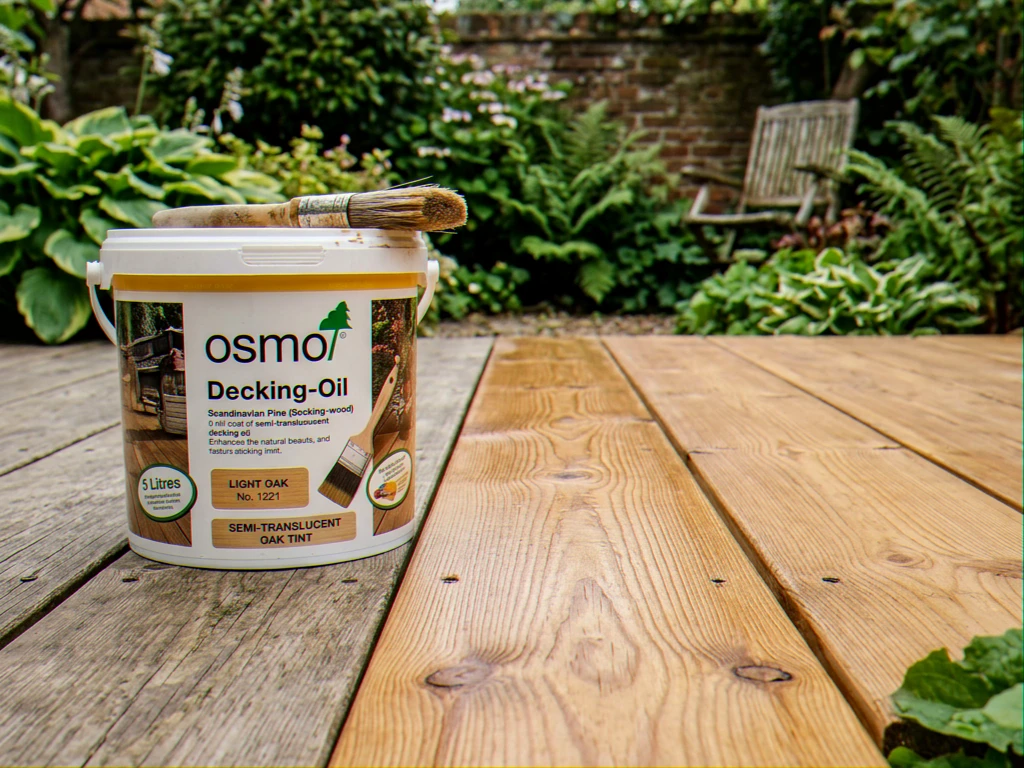
Compare decking oil sprayer costs and UK oiling budgets

These cost tables compare decking oil, sprayer, hire and labour costs before you choose a DIY route. The figures below are pulled from current UK retailer and hire listings, representing realistic national ranges and averages calculated for the UK market.
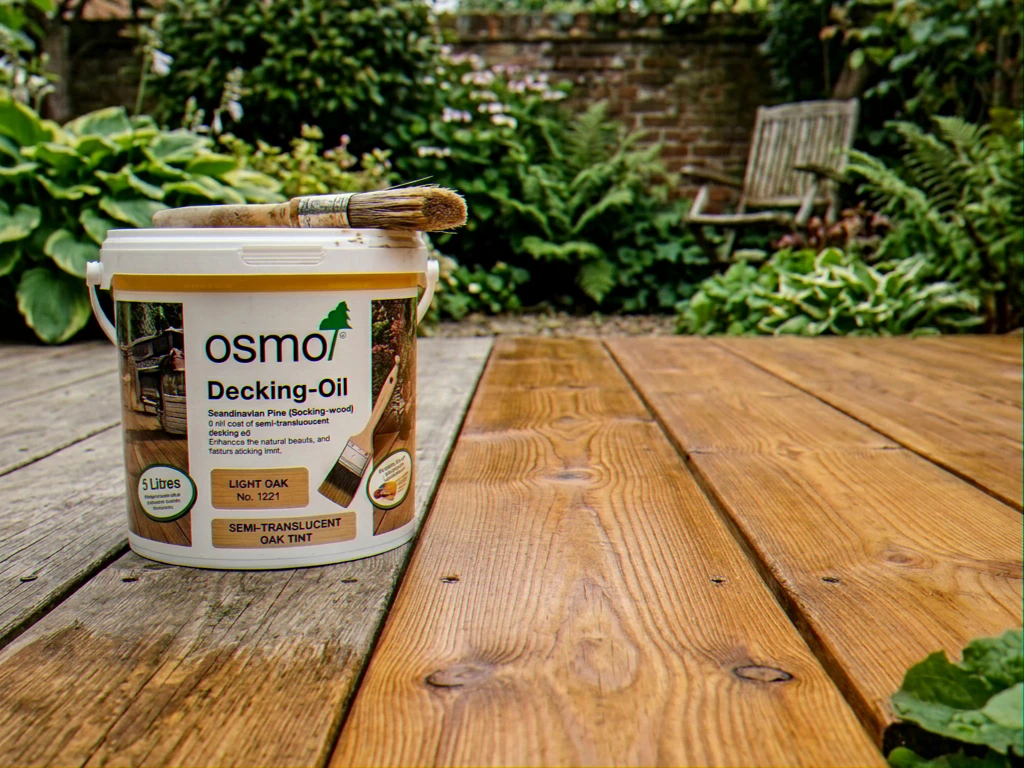
Decking oil cost per square metre

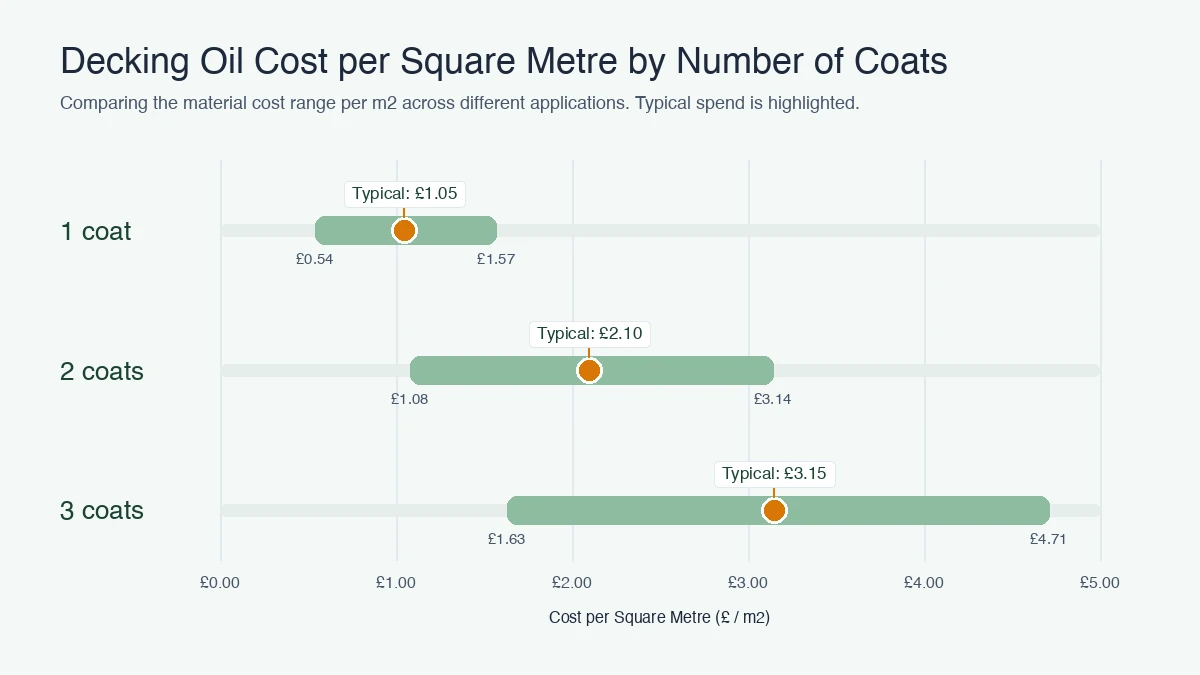
Decking oil is sold by the tub and applied in one, two, or three coats. Cost per square metre depends on the oil and how many coats the timber needs. Two coats are the usual maintenance specification.

One coat of decking oil colour depth
1 coatLight, translucent warm oak tint.
Two coats of decking oil colour depth
2 coatsMedium, even protective depth.
Three coats of decking oil colour depth
3 coatsRichest, deepest protective colour.
Decking oil cost per square metre by number of coats
Coats Minimum per m2 Typical per m2 Maximum per m2
1 coat £0.54 £1.05 £1.57
2 coats £1.08 £2.10 £3.14
3 coats £1.63 £3.15 £4.71
Decking oil cost per square metre comparison diagram

By the litre, the cheapest oil I costed is Barrettine Decking Oil at £8.47 per litre and the most expensive is Osmo Decking Oil at £27.21 per litre, against a typical £12.01 per litre across eight common oils. A higher-coverage oil such as Cuprinol UV Guard, rated at 16 m2 per litre per coat, works out cheaper per square metre than its tub price suggests.

How much does a decking oil sprayer cost?

A domestic decking oil sprayer costs £29.99 to £426.55 in this comparison. Budget models range from £29.99 to £69.99, the Wagner Fence and Decking Sprayer defines the mid tier at £56.27 to £59.98, and trade or premium sprayers start at £135.67.

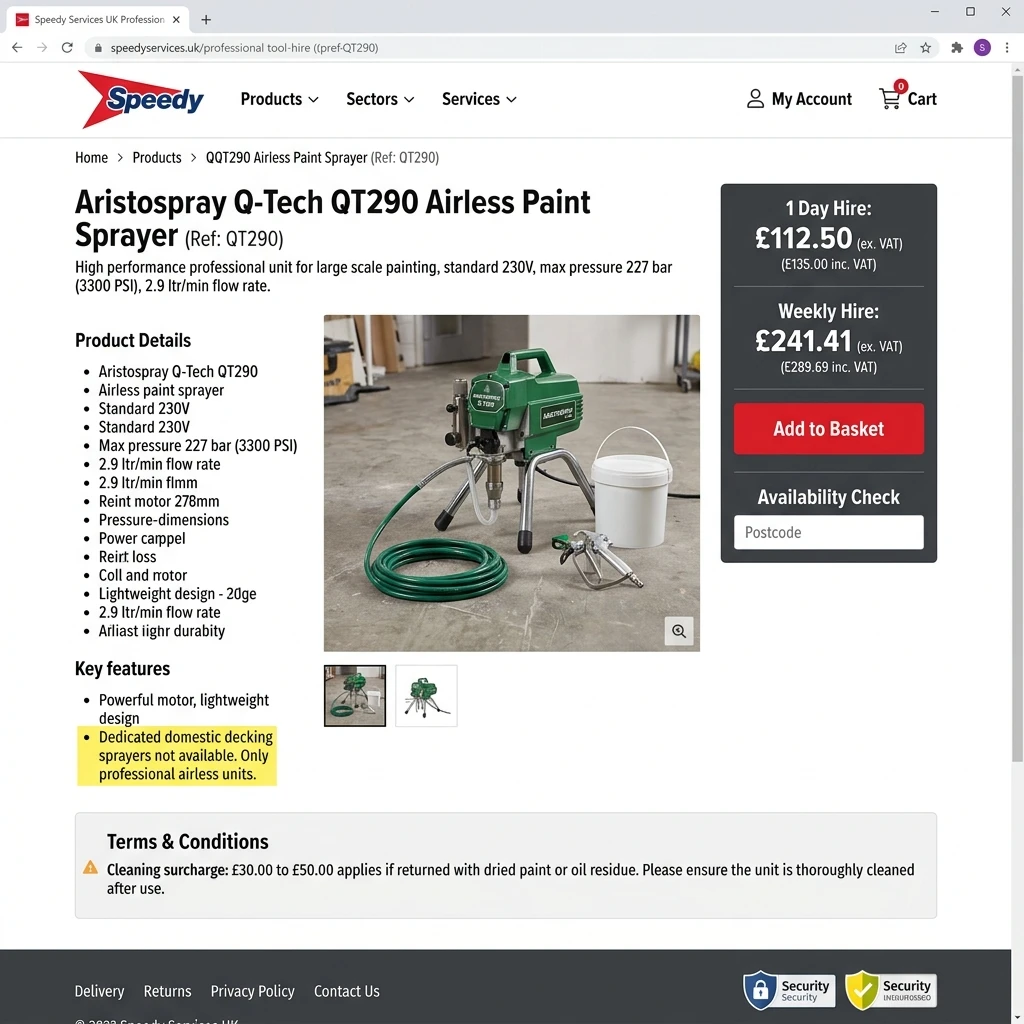
Decking oil sprayer rental is the alternative to buying, but dedicated domestic decking sprayers are not available to rent. Hire shops only lease professional airless units such as the Q-Tech QT290. A first day costs from £70.00 to £155.00, with a typical day around £112.50, all excluding VAT. Rental is subject to 20 percent VAT and may carry a cleaning surcharge of £30.00 to £50.00 if returned with dried oil residue.
Q-Tech QT290 tool hire listing proof and cleaning surcharge claim
Domestic decking sprayer cost tiers
Tier Minimum Typical Maximum
Budget £29.99 (VonHaus 400W) £48.00 £69.99 (Erbauer EPS800)
Mid (Wagner Fence and Decking) £56.27 £58.13 £59.98
Trade or premium £135.67 (Wagner W 590) £239.03 £426.55 (Wagner Control Pro 250 M)
Domestic decking sprayer cost tiers comparison diagram

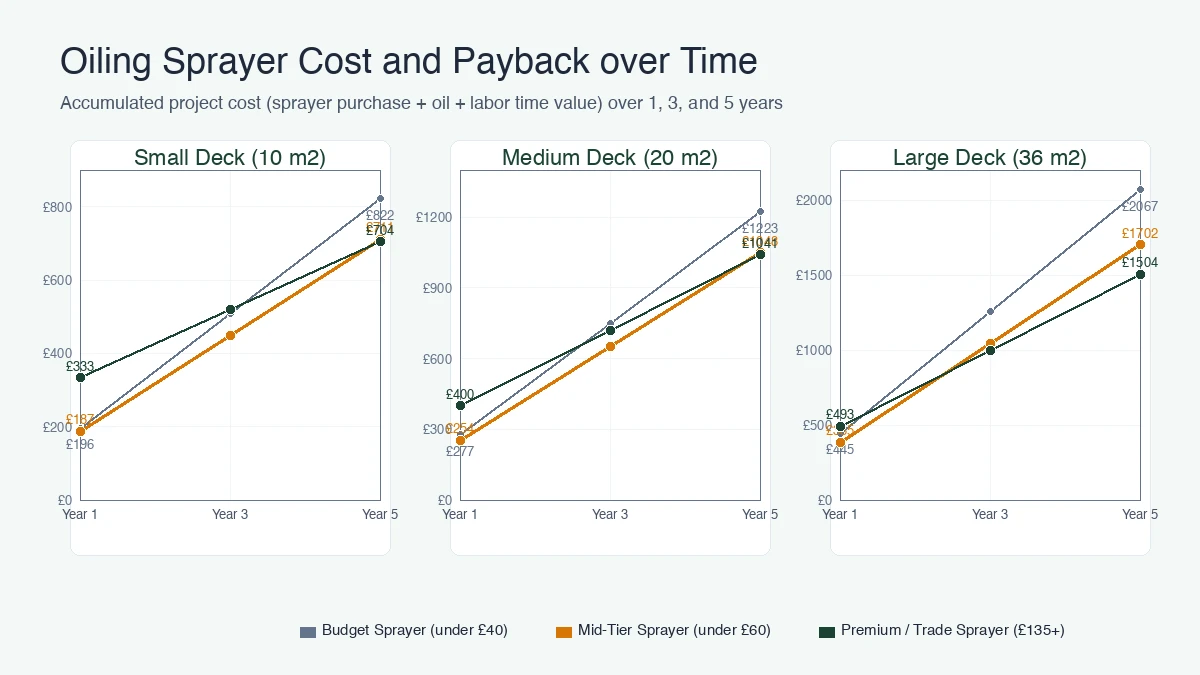
On a small 10 m2 deck, the deciding factor is payback time, not the upfront price. My costed scenarios make DIY brushing £73.85 and the Wagner Fence and Decking Sprayer route £130.12.

The £56.27 sprayer saves about one hour per session on a small deck, or about £12.71 at the National Living Wage benchmark each oiling. Payback comes to around four to five sessions, or just over two years of twice-yearly maintenance. A budget sprayer under £70 costs less upfront, but the test log decides it: the mid-range Wagner sprayed thick decking oil unthinned on my 6 m2 pass.

A trade or premium sprayer over £135 does not pay back on 10 m2 because the deck does not use enough oil or time to recover the extra cost. Those sprayers only make sense above about 25 to 30 m2 or for regular fence-plus-deck work.

Decking oil consumables and tools

Beyond the oil and the sprayer, a decking job needs cleaning, preparation, masking, and protective equipment. These costs are largely fixed regardless of deck size.

Associated consumable and preparation tool costs
Item Minimum Typical Maximum
Decking cleaner or restorer (5L) £12.50 £15.49 £30.00
Sandpaper or hand sander (buy) £5.00 £50.00 £120.00
Floor sander hire (daily) £15.00 £56.68 £94.47
Brushes or applicator pads £3.00 £12.00 £20.00
Masking tape and dust sheets £3.00 £8.00 £25.00
PPE (A2P3 mask, gloves, goggles) £15.00 £42.00 £58.00
Pressure washer (buy) £60.00 £150.00 £350.00
Pressure washer hire (daily) £6.30 £26.45 £50.00
Typical full kit total £119.80 £360.62 £747.47

In practice most people do not buy every item on this list for one deck. You may already own a pressure washer, sandpaper, and masking materials, so the typical extra spend on consumables and prep kit is closer to £50 to £100 for a single oiling. The total row shows what a complete from-scratch setup looks like, which is useful if you are starting with no tools at all.

Decking waste disposal, skip hire, and permits

If you are replacing boards rather than just re-oiling, you will generate timber waste. Skip hire is priced weekly by size.

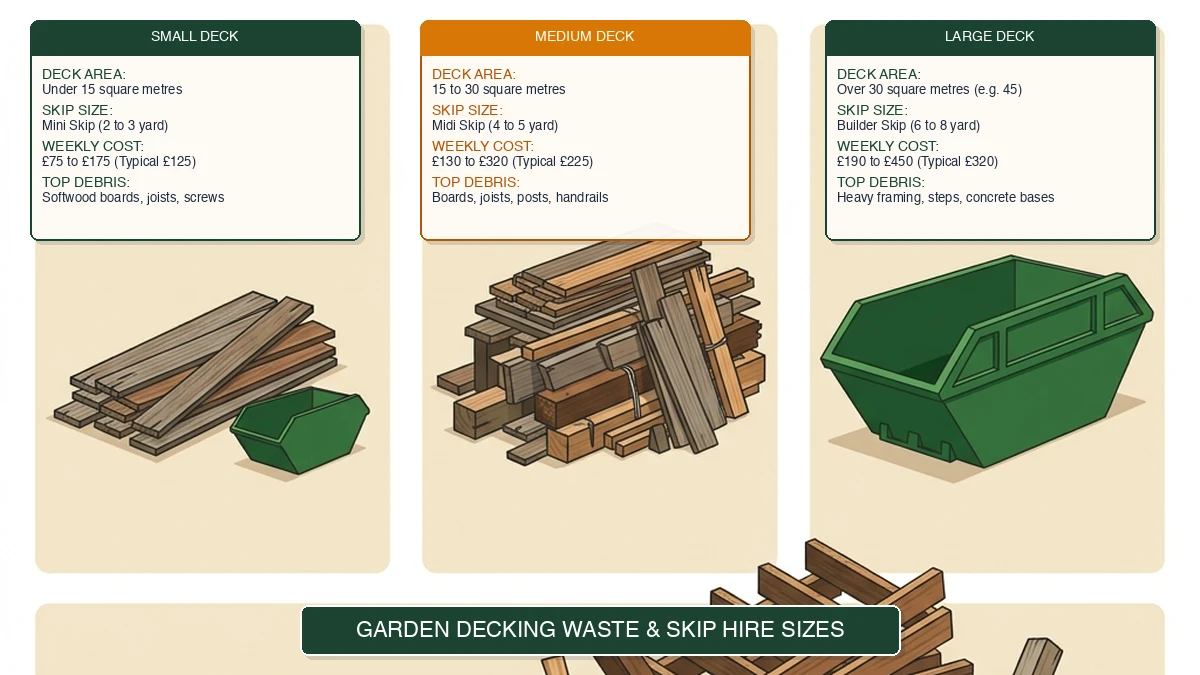
Skip hire costs by skip size
Skip size Minimum Typical Maximum
Mini (2 to 3 yard) £75.00 £125.00 £175.00
Midi (4 to 5 yard) £130.00 £225.00 £320.00
Builder (6 to 8 yard) £190.00 £320.00 £450.00
Diagram showing patio and decking sizes with the number of skips needed for rubble disposal

A council road permit is needed if the skip sits on a public road or footpath, costing from £15.00 to £60.00, with a typical £37.50. You can often avoid skip costs entirely: under UK rules, households disposing of their own DIY timber waste at a Household Waste Recycling Centre are not charged, typically within limits of up to 100kg or two large items per visit, up to four visits per month. Above those limits, or for waste from paid tradespeople, expect small excess charges of £5.00 to £15.00, up to a commercial rate of £250.00 per tonne at transfer stations.

Deck oiling labour: DIY benchmark versus professional

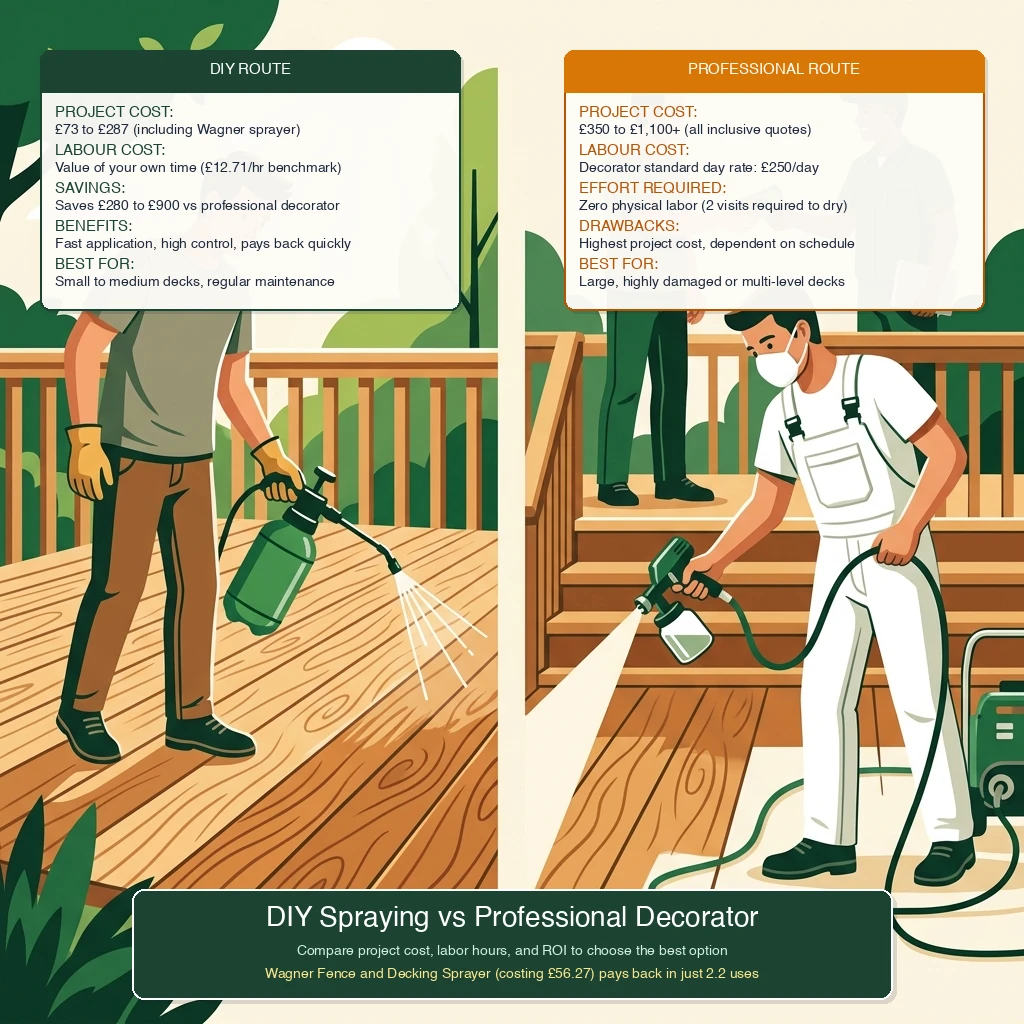
If you hire it out, a professional decorator or carpenter working alone charges from £180.00 to £450.00 per day, with a national average around £250.00 per day. A crew of two to three people charges from £350.00 to £800.00 per day, with a typical £550.00 per day. Most jobs need two visits, because cleaning and pressure washing must dry for 24 to 48 hours before oiling.

DIY versus professional deck oiling labour cost comparison diagram

If you do it yourself, the labour cost is your own time. I value that time against the UK National Living Wage of £12.71 per hour, the current rate for workers aged 21 and over from . On that benchmark a small 10 m2 deck takes about 5.5 hours, worth £69.91; a medium 20 m2 area of softwood decking takes about 9.5 hours, worth £120.75; and a large 36 m2 deck takes about 15.5 hours, worth £197.01.

Hiring a professional for the whole job typically costs £350.00 for a small deck section, £600.00 for a medium deck, and £950.00 for a large area of timber.

Deck oiling project scenarios: DIY versus professional

The tables below combine oil, consumables, disposal, and labour for three decking sizes. The DIY sprayer column includes buying the Wagner Fence and Decking Sprayer at £56.27. The professional column is the all-in quoted price.

Small 10 m2 deck oiling budget

Small 10 m2 deck cost scenarios
Approach Total project cost DIY time
DIY, brushing by hand £73.85 5.5 hours
DIY, buying a Wagner sprayer £130.12 3.5 hours
Professional decorator £400.00 0 hours

Medium 20 m2 deck oiling budget

Medium 20 m2 deck cost scenarios
Approach Total project cost DIY time
DIY, brushing by hand £133.67 9.5 hours
DIY, buying a Wagner sprayer £189.94 5.5 hours
Professional decorator £680.00 0 hours

Large 36 m2 deck oiling budget

Large 36 m2 deck cost scenarios
Approach Total project cost DIY time
DIY, brushing by hand £231.02 15.5 hours
DIY, buying a Wagner sprayer £287.29 9.0 hours
Professional decorator £1,100.00 0 hours
Sprayer payback diagram comparing cheap versus expensive sprayers for small, medium, and large decks over time

On a medium section of decking boards, spraying instead of brushing saves about two hours per session. Valued at £12.71 per hour, that is a time saving worth £25.42 each time you oil. A Wagner Fence and Decking Sprayer at £56.27 pays back in roughly 2.2 oiling sessions, around one and a half to two years of twice-yearly maintenance. Buying that sprayer is also cheaper than a single day of commercial hire, saving £27.73 on day one, and the DIY-with-sprayer route on a medium deck comes in £490.06 below the professional quote.

Decking oil sprayer FAQ

The decking oil sprayer FAQ answers the questions I get asked most often, including a few the big retailers leave unanswered.

Can decking oil be sprayed on?

Yes. Most penetrating decking oils can be sprayed with an HVLP or airless sprayer fitted with the correct nozzle (1.0 mm to 1.5 mm for HVLP; a 311 or 313 tip for airless). Always back-brush the wet oil immediately after spraying to push it into the wood pores. Spraying is faster than brushing but needs masking preparation and PPE for overspray control.

What is the best way to apply decking oil?

Spraying followed by immediate back-brushing gives the fastest, most even result on large decks. A wide pad applicator on a long handle suits smaller areas and produces less overspray. Brushing alone is thorough but slow on anything above 15 m². Whichever method you use, the wood must be clean, dry, and above 8 degrees Celsius before you start.

Is it better to roll or spray a deck?

Spraying is faster, covering 20 m² of decking in under 15 minutes with the right sprayer. Rolling leaves a slightly thicker film but can miss groove sides on profiled boards and tends to create lap marks if the section dries before you return. For grooved decking, spraying at 45 degrees plus back-brushing gives better groove penetration than either a roller or a standard brush alone.

How do you thin decking oil for a sprayer?

Most decking oils do not need thinning if the nozzle is the right size. If your sprayer struggles to atomise the product, thin water-based oils with up to 10% clean water and solvent-based oils with up to 10% white spirit. Test on cardboard first. Do not exceed 10% as overthinning reduces film build and shortens the life of the coating.

Do you need two coats of decking oil?

Softwood decking (treated pine, spruce) normally needs 2 coats to achieve full protection and a rich colour. Dense hardwood (ipe, teak, bangkirai) often accepts only 1 coat or 2 very thin coats because the tight grain resists absorption. Always check the tin: some manufacturers specify a single coat for maintenance applications on previously oiled wood.

Can you apply decking oil to wet wood?

No. Applying oil to wet or damp wood traps moisture and causes the finish to turn white, bubble, or peel. The wood must have a moisture content below 20% before oiling, and you need a rain-free window of 24 to 48 hours beforehand. A simple pin moisture meter costs around £10 and removes the guesswork.

What is the best way to apply decking oil to grooved decking?

Spray the oil at a 45-degree angle from one direction to coat one groove wall, then repeat from the opposite direction to coat the other side. Follow immediately with a stiff decking brush or a floor-broom on a long handle to push the oil into the groove bottoms and prevent pooling. Grooved profiles add up to 30% more surface area, so buy extra oil accordingly.

Is water-based decking oil better than oil-based?

Water-based and oil-based decking oils suit different situations. Water-based (acrylic) formulations dry faster (4 to 8 hours to recoat), have lower solvent odour, and clean up with water. Oil-based (alkyd or linseed) formulations penetrate deeper into the wood, are easier to spot-repair without visible joins, and tend to be more durable on well-used decks. Both types can be sprayed; water-based oils clean out of the sprayer more quickly after use.

Why does my deck turn black after applying decking oil?

Blackening after oiling is almost always caused by mould or algae growing beneath the oil film. It happens when the timber was not treated with a fungicidal wash before oiling, when the wood was still damp at application, or when the oil trapped existing mould spores. Strip the oil, treat the timber with a decking cleaner and fungicidal wash, allow it to dry fully, and re-oil. A preventative biocide wash each spring stops recurrence.

Can I treat my deck with used engine oil?

No. Used engine (motor) oil contains heavy metals and combustion byproducts classified as hazardous waste. It does not cure, leaves a sticky, dark film that attracts dirt, smells strongly, and contaminates soil. It offers no UV or moisture protection. Use a purpose-made penetrating decking oil instead. Disposing of used engine oil down a drain or onto soil is illegal in the UK.

Can I oil my deck before frost?

No. Decking oil needs temperatures consistently above 8 to 10 degrees Celsius to cure. If frost is forecast within 24 to 48 hours of application, the oil will not set, leaving a tacky surface that traps grit and debris. In the UK, the window for safe outdoor oiling is approximately May to mid-September. Oiling in October or later carries a high risk of coating failure.

What is the 3/4/5 rule for decking?

The 3/4/5 rule is a carpentry framing technique used during decking construction to check that a corner is exactly 90 degrees. From the corner, measure 3 units along one joist and 4 units along the perpendicular joist. The diagonal between those two marks must be exactly 5 units for a true square corner (based on the Pythagorean theorem: 3² + 4² = 5²). It is a frame-squaring rule, not an oiling or spacing rule, and has no bearing on how decking oil is applied.

Why is my Wagner fence and decking sprayer not spraying?

The most common causes are a blocked nozzle, air in the hose, or oil that has thickened in cold temperatures. Remove and soak the nozzle in the appropriate solvent (water for water-based oils, white spirit for solvent-based). Check that the suction tube is fully submerged in the material. Thin the oil slightly if the ambient temperature is below 10 degrees Celsius. Refer to the Wagner support pages for model-specific diagrams and spare part numbers.

Does the Wagner fence and decking sprayer need an extension lead?

Yes. The Wagner Fence and Decking Sprayer ships with a 1.8-metre power cable, which is rarely long enough to cover a full section of garden decking from one socket. Use a heavy-duty outdoor extension lead, rated for the sprayer's wattage. Keep all connections dry and off damp ground. Check the lead is fully uncoiled to prevent heat build-up.